
|
Welcome to a brand of
Mathematical
Services. 2026-11-06 09:42:18 - Paul D. Foy - Dursley This is a post on Dursley, a small town in Gloucestershire, midway between Gloucester and Bristol. You might ask me why I am making a post on Dursley. The reason is I lived here for a considerable period of time. I lived here for about 30 years until I had a serious spinal injury, which caused me to have to move house nearer to where I was born, in fact to the place I was born. There have probably been three stages to my life: 1. Up to 25 years was spent on education, going to school and going to university, doing a PhD, that kind of thing. 2. The period of time for 30 years at Dursley was spent working for other people and I think that's how I generally define the term: I was working for other people. I was in their control. I was under the control of other people. I was being paid by other people to do their work. I think that's a reasonable definition of work. To tell the truth I do use the term loosely for very many other contexts when I'm just busy doing something but that was the formal work I undertook. It was brought to an end, for certain, to tell the truth, when I had this spinal injury. 3. The period after 1. and 2. Just as I had stopped working just prior to my spinal injury, when I probably was regarding myself as almost retired, I was getting into history and making little postcards and things like that. I was taking photographs of the long barrows and the archaeological monuments in the area. I was just on the foothills of getting into the history of things, the history of Dursley. Since I retired and since I came back to Birkenhaw, where I was born, I've done a lot of investigation into history, into the historical accounts of the names of things, and all these kinds of things around where I'm living now. I felt if I'd continued to live in Dursley I would have done it there because I was just getting into this. It was a new interest. I was combining it with mathematical interest in a way as well. What surprised me (and to tell the truth there was no mention of this by the locals or by any of the talks I went to in Dursley) was the actual historical background of Dursley itself. It seems the place is rather similar to Bradford, perhaps similar to many places, in the way the Industrial Revolution developed. For in the 17th and 18th centuries Dursley and the area within the Stroud area, but Dursley in particular, was a great centre of weaving, weaving wool. In fact women undertook much of this weaving in their homes on weaving looms. In fact Dursley had some of the earliest mills in the area because it was situated on the River Ewelyn, perhaps called the River Cam, which runs through the centre of Dursley and then on to Cam in the Draycott area. It was water wheels and water mills that were powering the weaving equipment in the early mills. Indeed Dursley flourished early on in the 19th century as its water mills got going. It was quite early on that it had an industrial phase when coal- and steam-generated mills came along. The area did partake in the Industrial Revolution and indeed there were, by some accounts, about 180 mills in the Stroud and Dursley area at one stage. They seem to have quite rapidly fallen into decline quite early on in the 19th century and the place didn't flourish in the same boomtown way as Bradford did. I don't know. I can only speculate on the reasons. To tell the truth it might have been that there wasn't the same ready access to coal. Coal had to be brought from across the River Severn from the Forest of Dean area and the Midlands coalfields. I think there were small coalfields in South Bristol although I may be wrong there. For some reason it declined and it couldn't compete with other areas. What there was became a bit of an oversupply in the area and the industry died out more than it did in the Bradford and West Yorkshire region. Still I did come across vestigial people doing these traditional trades. When I was in there I came across a lady shoemaker making traditional shoes. Rather expensive, to tell the truth, but too expensive to buy. This employment of women, and in particular women, was very characteristic of Dursley, which I didn't realise. In the same way, of course, it was women and children that populated the mills of Bradford. I don't know whether that was the same in Dursley. Cam Mills is still an existing mill in Dursley, next door to Dursley, midway between Dursley and Cam. It's still operational. It had a cunning strategy to avoid going bankrupt by transitioning between the home industry of weaving and mechanised weaving, by doing part-time home and factory work. That managed to get it to survive and it now survives on specialist cloths: tennis balls, billiard table cloth, that kind of thing. It's still in existence and it was nearby where I lived. The picture accompanying this post in the next comment shows a lady working in this mill in the not too distant past. 2026-11-06 10:21:42 - Paul D. Foy - I need to attribute the author of the previous photograph in the previous comment. It is from By Chelalinda - Own work, CC BY-SA 4. 0, https://commons. wikimedia. org/w/index. php?curid=87066001. 2026-11-06 10:19:42 - Paul D. Foy - The process of weaving is, in principle, a rather simple one. There are two arrays of fabric, two arrays of yarn. There is the warp running from top to bottom and the objective is to interlace the weft running from left to right between the threads of the warp to create a cloth or to create patterns (depending upon how you interlace the two threads). Now you would be surprised how common throughout history and in a historical context weaving is. It is present in almost all cultures and there have been home industries of weaving in almost all cultures. It's probably true to say that the mechanisation of weaving began with the Industrial Revolution and my town of Bradford is very much a harbinger of that (although perhaps Manchester as well, with Arkwright's spinning Jenny). But hand weaving has been going on for millennia. Indeed it's considered that the South American people were responsible for independently inventing almost every non-mechanised form of weaving that is known. The picture shows a Mayan lady of Guatemala using a backstrap weaving technique, so called because one of the ends of the warp is held by and tensioned by a backstrap worn by the wearer. Very simple. One could probably do it anywhere. 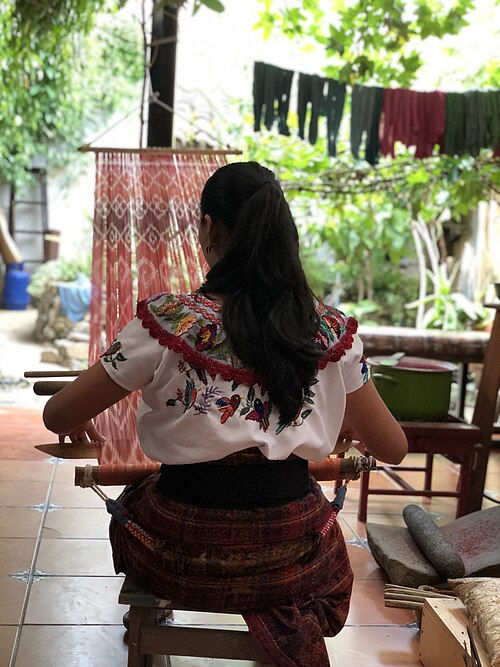 2026-11-06 09:44:13 - Paul D. Foy - I photograph of a lady working in Cam Mills. 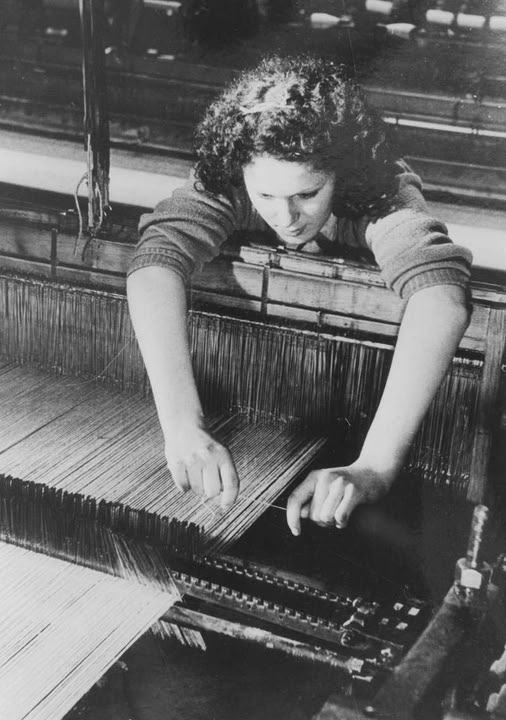 Post a comment: |